Why Indian creators should own their own audience in 2027
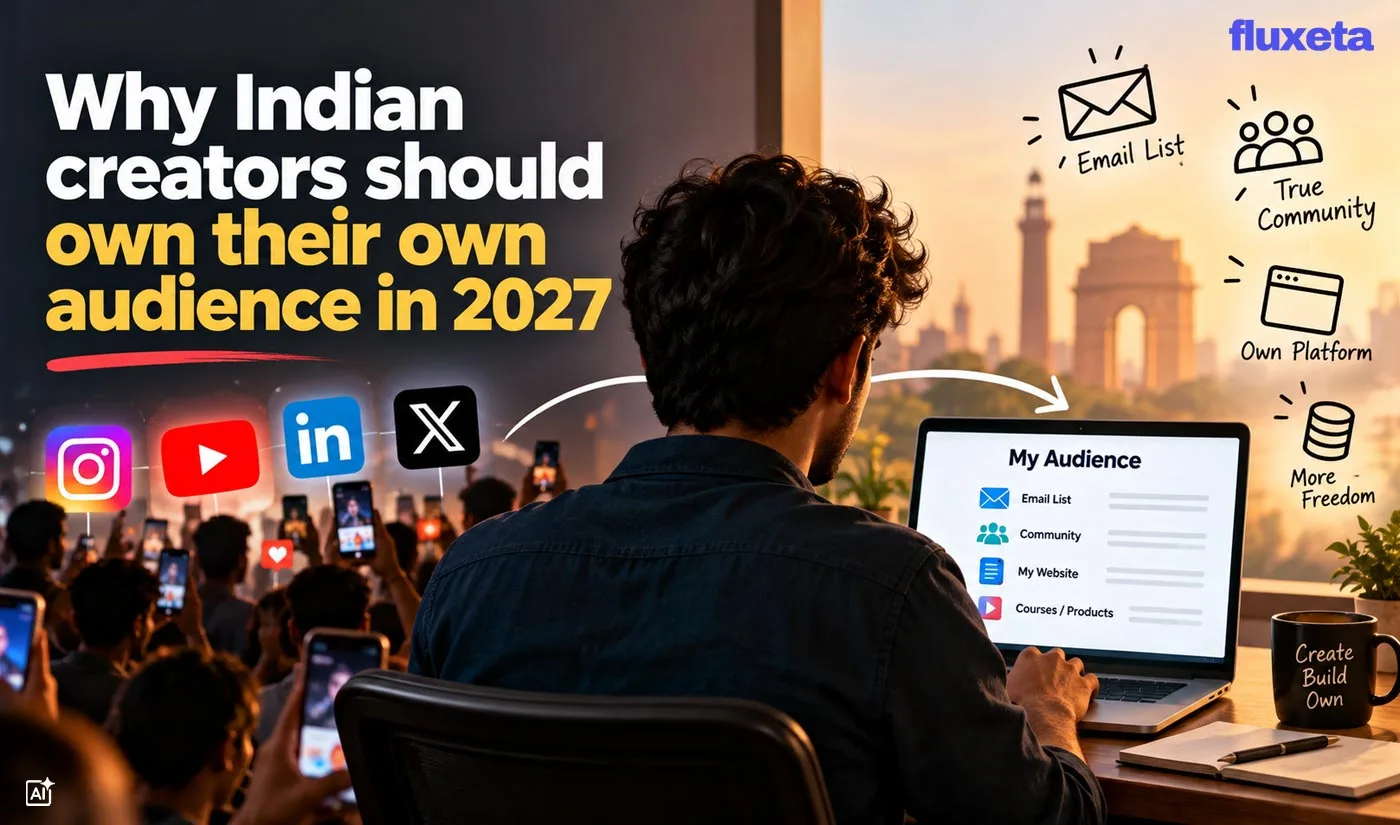
I find myself having the same conversation with creators over and over. It usually goes like this.
"How many Instagram followers do you have?"
"About 340K."
"How many of those followers could you actually reach if Instagram blocked your account tomorrow?"
There’s a pause. "I have their DMs. Some of them."
"That is not the same thing."
An even longer pause follows.
I want to put this conversation into words. Every Indian creator I know talks about "owning your audience," agrees at conferences, and then keeps building their business on platforms they don’t control. In this post, I want to explain why it’s especially important to change that in 2027.
What people mean when they say it
People talk about "owning your audience" as if everyone agrees on what it means. But in reality, everyone has a different idea.
For some, it means having a website. For others, it’s about building an email list or starting a paid membership. These are all connected, but none of them cover everything.
For Indian creators, truly owning your audience means you can reach the people who care about your work without needing approval from any platform. That’s all it is. If you can message your 10,000 biggest fans directly, without anyone in the middle, you own your audience. If not, you’re just renting it.
Most Indian creators I know are relying on three or four different platforms at the same time, but they don’t really control any of them.
The five things any platform can take from you at any moment
Let me be clear: I am not saying platforms are evil. Most of the time, they are just companies with targets to hit and legal teams to answer to. When they make changes, it is almost never personal.
Still, that does not change what they can do without warning, any day of the week:
Cut your reach. YouTube might stop showing your videos in the algorithm. Instagram could suddenly give your Reels only 12 percent of last quarter’s traffic. There is nothing you can do about it. You still have your followers, but it becomes much harder to reach them.
Cut your income. YouTube might demonetise your channel over a policy that even their team cannot explain. Reels bonuses can disappear without warning. Sponsorship sites can change their fees. Ad markets can drop for a while.
Change the rules. Substack had a big public debate in 2023 and 2024 about what political content it would allow. Twitter became X and changed its algorithm three times in two years. Every update tests whether your business can keep working there.
Ban you. This is rare, but real, and the appeals process at most platforms is between opaque and non-existent. If a competitor mass-reports you, or if an AI moderation system misreads a caption, you can lose an account you spent five years building in one afternoon.
Get sold. Platforms can be bought and changed. Vine shut down. Path shut down. Twitter changed owners. The audience you built on those platforms does not move with you.
Each of these events is unlikely on its own. But if your whole business depends on platforms you do not control, the chance that at least one will happen to you in the next five years is almost certain.
What owning your audience actually looks like
There are three layers. If you miss even one, the other two are weaker.
Layer one is your own web address. It could beyourname.comoryourbrand.in—something you registered yourself and renew each year. If your whole online presence is just instagram.com/yourhandle, you do not really have a home online. You are just renting space in someone else’s building.
Layer two is your own reader list. This means email addresses, WhatsApp numbers, or both, stored somewhere you can export them. Most creators skip this step because it seems boring, but it is the one thing that has survived every platform change in the last twenty years. Email lists from 2010 still work today. Nothing else from 2010 does.
Layer three: your own way to charge money. A payment relationship where the reader pays you, not a platform that pays you later. On Fluxeta, this means bring your own Razorpay or UPI Autopay. On other stacks, it means Stripe, Ghost payments, whatever. The point is that the money hits your Indian bank, not a platform account that takes weeks to release.
Most Indian creators do not have any of these three. Some have one, usually just the domain. Very few have all three.
If you have all three, a platform ban is just a bad month. If you have none, a ban could end your business.
The Indian-specific case for doing this now
Two recent changes have made it more valuable for Indian creators to own their audience than it was in 2023.
UPI Autopay and recurring digital payments have givenIndian creators practical ways to set up ongoing INR payments directly with their audiences, instead of relying only on platform monetisation. Now, owning your monetisation is much more realistic than it was a few years ago.
The DPDP Act is another big change. India passed a real data protection law in 2023, and its rules are becoming more important for businesses that handle personal data. If your audience data is stored on a foreign platform, you have less control over it than if you manage your own data. This doesn't mean every creator needs to build a database right away, but it does mean you need to think about owning your audience and managing data responsibly.
Neither of these changes forces you to move. Both of them mean that if you do move, you land somewhere that fits your business better than it would have five years ago.
The uncomfortable part
I will be honest; this is not free.
You can set up your own domain in an afternoon. Building an email list from scratch takes at least six months of steady effort, sometimes even a year. Setting up UPI Autopay with your own Razorpay keys takes about half a day the first time. Getting your first ten paying subscribers on your own platform is honestly harder than getting them on a platform with built-in discovery.
Nobody tells you this at conferences. The people at conferences telling you to own your audience already have theirs.
Here is my advice: do not move everything at once. Keep posting on Instagram and uploading to YouTube. Add your own platform alongside these. Mention your newsletter in every video description. Every third Reel can say, "The full breakdown is on my site." Moving slowly builds momentum, while moving too quickly can cause problems.
Figuring out when it actually pays off
I’ve seen many creators go through this process. Here’s what usually happens.
If you have fewer than 10,000 followers, it’s not worth the effort yet. Instead, focus on creating things people want to share.
Once you reach between 10,000 and 100,000 followers, start building your own channel alongside your main one. Set up a website, an email list, and maybe offer one paid product. Don’t expect this to become your main income source right away.
Once you have more than 100,000 followers, your own channels become the main place to earn real money. Sponsorships get bigger since you can offer things like email placements and website takeovers. Memberships start to make sense because even a small percentage of your audience adds up. At this point, your platform channels mainly help people discover your owned channel, which is how it should work.
When you pass 500,000 followers, you’re running a media business, even if you didn’t plan to. If you’re still managing everything inside a platform, it’s time to move your operations elsewhere.
Looking at the bigger picture
I don’t think platforms are going anywhere. Instagram will probably still be around in 2030. YouTube will likely be here in 2035. Substack will probably stick around in some form too.
But I also believe the creators who last until 2035 won’t be the ones who put their whole business on just one platform. The ones who stick around will use platforms for what they’re good at, reach, discovery, and entertainment, but keep the important things, audience, income, and data, on their own turf.
"Own your audience" isn’t just a catchy phrase. It’s about making steady, sometimes dull decisions, one small step at a time, usually when things are calm. Any ordinary Wednesday works, ideally before something goes wrong.
If you want to start the owned layer today, our custom-domain guide walks first-time creators through the DNS setup. That one is at fluxeta.com/blog/custom-domain-setup-india-creator.
If you already have a domain but don’t know what to put on it, the platform's free Home Builder templates are a good starting point. No design skills needed.
Try Fluxeta free
Newsletter, blog, courses, videos, memberships, link-in-bio, and booking — all-in-one, INR-native, no duct tape.
Start free →